What must appear on a food label? This overview shows the information required by law – from the name of the food and allergen information to the nutritional declaration – and explains the aspects to bear in mind regarding presentation, language and origin.
What must appear on a food label
Anyone who sells prepacked foods must ensure that the label includes all the required information. This also applies to foods sold online. The FSVO provides information on the legal basis of these indications and their significance. The cantonal enforcement authorities are responsible for assessing whether an individual label is legally compliant.
Below you can find out about the typical information shown on a label on the basis of an imaginary product.
1. Product name
The name of the food clearly shows what the food is. Consumers must be able to clearly distinguish the product from similar foods – for example ‘whole milk yoghurt’, ‘jam’, ‘Bircher muesli’, ‘nut croissant’ or ‘soya cream dessert’.
A legally prescribed name may only be used if the product meets the requirements (for example ‘milk’ in accordance with the Ordinance on Foodstuffs of Animal Origin or ‘chocolate’ in accordance with the Ordinance on Foodstuffs of Vegetable Origin, Fungi and Table Salt). If no such name exists, a customary or descriptive name should be used.
The name of the food is not usually the same as the product’s brand name or invented name. Invented names are unregulated, made-up names that designate the product but don’t accurately describe it. Use of an invented name is optional, whereas the name of the food is mandatory. For a food with the name ‘crispy cereal mix with cashew nuts’, the invented name could be ‘Morning Crunch’, for example.
If the foodstuff has been specially processed and omission of this information could be misleading, the name of the food must be supplemented – for example with:
‘defrosted’
‘pasteurised’
‘reconstituted’
‘treated with ionising radiation’
Additional information about the product name of vegan and vegetarian alternatives to foods of animal origin:
Certain information must appear in the same field of vision as the product name – for example if it is relevant to health or if it is particularly important to consumers.
The field of vision rule is designed to ensure that this information is clearly visible, is communicated transparently and that certain information is legible at a glance without having to turn the packaging over.
For example, the following information must appear in the same field of vision as the name of the food:
Alcohol content ‘in % vol.’ for beverages with more than 1.2% by volume of alcohol
Declarations according to the Agricultural Declaration Ordinance (AgDO) such as ‘May have been produced using hormonal performance-enhancing substances’ or ‘May have been produced using non-hormonal performance enhancing substances, such as antibiotics’.
Information on the production method of foods of animal origin, such as ‘produced using painful procedures without anaesthesia’.
Quantity information in accordance with the Ordinance on Indications of Quantity (MeAV).
The label ‘Contains caffeine. Not recommended for children or pregnant women’ on foods (excluding beverages) to which caffeine has been added for physiological purposes
2. List of ingredients
The ingredients list shows all the ingredients in a food – in descending order by weight during production. The closer an ingredient is to the beginning of the list, the more of it there is in the product. Ingredients that may cause allergies or other adverse reactions must be clearly labelled.
The ingredients are listed in descending order by weight percentage – including their name.
People with allergies rely on clear labelling. The most important ingredients that may cause allergies or other adverse reactions (allergens) must therefore be clearly labelled.
Under food law, the following ingredients and products derived from them are required to be labelled as allergens:
Cereals containing gluten, particularly wheat (spelt and Khorasan wheat), rye, barley, oats or their hybridised strains
Shellfish
Eggs
Fish
Peanuts
Soybeans
Milk (including lactose)
Nuts, including the name of the type (e.g. hazelnut)
Celery
Mustard
Sesame seeds
Sulphur dioxide and sulphites in concentrations over 10 mg/kg or 10 mg/l (expressed as SO₂)
Lupins
Molluscs
The ingredients listed above either very frequently cause allergies or other adverse reactions, or the reactions caused are extremely serious.
These ingredients must be clearly highlighted in the ingredients list – for example in bold, CAPITAL LETTERS or underlined. Other suitable highlighting is also allowed. If there is no ingredients list, this can be conveyed using the word ‘contains’, for example ‘contains sulphite’ for wine. If an ingredient is derived from an allergen, this must be clearly indicated (for example ‘soy lecithin’ and not just ‘lecithin’).
Allergens that are present unintentionally (for example due to contamination) must be indicated if they may reach or exceed certain limits. If the allergen content is above the limit value, precise information is required. If it is below, the information is voluntary. In that case generic terms such as ‘cereals containing gluten’ or ‘nuts’ may be used.
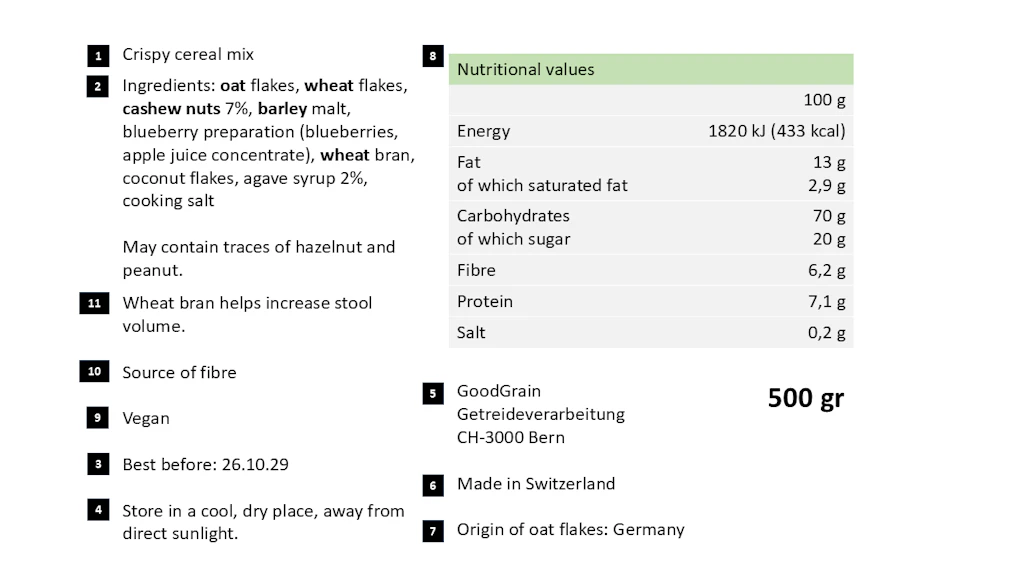
Example: Ingredients: oat flakes, wheat flakes, cashew nuts 7%, barley malt, blueberry preparation (blueberries, apple juice concentrate), wheat bran, coconut flakes, agave syrup 2%, cooking salt May contain traces of hazelnut and peanut
No ingredients list is required for the following foods:
Fresh fruit and vegetables, including potatoes as long as they are not peeled, cut or processed in any other way
Products with only one ingredient if this is clear from the product name (for example sugar)
Dairy products such as cheese or butter if they only contain certain ingredients
Certain ingredients must be declared with a quantitative declaration (in %) – if they:
are depicted on the packaging (for example fruits on a label)
feature in the name of the food (for example ‘strawberry yoghurt’)
are typically associated with the product (for example potatoes in rösti croquettes)
characterise and distinguish the food from others (for example eggs in mayonnaise)
3. Food date labelling
Nearly all foods must be dated – with few exceptions, such as fresh fruit and vegetables, vinegar and table salt. Food law draws a distinction between best before dates and use by dates.
The type of dating used depends on the recipe, the manufacturing process and the shelf-life risk – there is no generally applicable rule.
The best before end date (‘best before’) indicates how long a food will retain its quality (such as taste, smell, colour, consistency) if it is stored correctly. This is about quality and not safety.
Many products can still be enjoyed after the BBE – as long as they smell, look and taste OK.
Examples of foods with BBE: crisps, salami, smoked ham, butter, yoghurt, curd cheese, hard cheese, eggs, fruit juice.
The use by date (‘use by’) is required on particularly perishable foodstuffs. These products have an increased risk of disease-causing germs multiplying or harmful substances forming. They must also be stored refrigerated.
The use by date is about food safety. It indicates until when a food can be safely consumed without a risk to health as long as it has been kept in the fridge. The product must not be sold or used after this date. Safe consumption is no longer guaranteed – even if it smells, looks and tastes normal. Consumer health outweighs the goal of avoiding food waste.
An indication that a product should be stored in the fridge does not automatically require a ‘use by’ date. For less perishable products – such as yoghurt – a best before date is sufficient.
Examples of foods with a use by date: fresh meat, pasteurised cured meat products, soft cheese and cream cheese, filled rolls and sandwiches, fresh pizzas, fresh or pasteurised ready meals, pastries, prepared salads, bean sprouts
The FSVO commissioned the Zurich University of Applied Sciences (ZHAW) to work up a basis for decision-making on the dating of foods. It is documented in the following report (in German only):
No date labelling is necessary on certain foods, including fresh fruit, vegetables, bread and products with a long shelf life such as alcoholic beverages containing 10% or more by volume of alcohol, chewing gum, vinegar, salt and solid sugar. For these products the shelf life is determined by individual requirements and the state of the product.
Foods may be sold after the best before end date has expired as long as quality and safety are guaranteed and consumers are not misled.
Further information on the sale of foods after expiry of the best before date:
Some foods have to be stored or used under certain conditions. This information must appear on the label.
Examples of such indications:
“After opening, do not store in the tin. Keep in the fridge and use quickly.”
“Frozen product. Always store in the freezer compartment at a temperature of at least -18 °C. Once defrosted, consume immediately.”
“Intended for cooking only”
“Store away from sunlight”
Such information helps maintain quality and safety for consumers.
5. Address
The label must include the name and address of the company or individual that produces, imports, packages, wraps, fills or sells the food – generally this is the distributor.
This may be a natural person or a legal entity. The head office does not need to be in Switzerland.
If the address is considered to be the indication of the country of production, it must include at least the country, postcode and town/city.
6. Country of production
The country of production must be indicated on foods sold in Switzerland. It designates the country in which a food was manufactured in its entirety – or processed in a way that gave it new properties or a new name.
This information is mandatory for all foodstuffs. However, there are a small number of exemptions. No indication is needed if:
the country of production is clear from the name of the food (for example Scotch whisky).
the country of production is clear from the address of the manufacturer
For processed foods, a geographical area can be stated instead of a country, for example ‘EU’ or ‘South America’. The indication may also be stated using an ISO-2 country code, for example ‘IT’ for Italy.
For fish products caught at sea, the fishing area must be indicated, for example ‘Northwest Atlantic’.
Further information on country of production indication for foodstuffs and ingredients:
For compound foods it may be necessary to indicate the origin of individual ingredients as well as the country of production – for example the country of origin of tomatoes in a tomato concentrate.
For prepacked foods, the origin of an ingredient must be indicated if there is a danger that the packaging may be misleading for consumers. This is the case if:
the ingredient is present in significant quantities and
the product’s presentation implies incorrect origin of the ingredient.
Ingredients of animal origin are considered to be present in significant quantities if they constitute 20% or more of the end product (for example a lasagne containing more than 20% beef). For all other ingredients the threshold is 50%.
The packaging is considered misleading if it suggests that an ingredient comes from a certain country although this is not true. Crucial factors include:
Product name
Images
Overall presentation of the product
Assessment is always on a case by case basis.
Example: A ‘Sugo Toscano’ contains tomatoes from France. The packaging features Italian design elements – such as the Leaning Tower of Pisa, and words such as ‘traditional’ or ‘della nonna’. This presentation may give the impression that the product comes entirely from Italy – including the tomatoes. If this is not the case, the origin of the tomatoes must be declared.
No indication of origin is needed for product names that cannot be linked to a country of origin, such as ‘Wienerli’ or ‘exotic fruit salad’.
For voluntary indications, a geographic area may be used (such as ‘EU’ rather than individual countries).
The origin of the ingredient must be shown in the ingredients list or in the same field of vision.
The nutrition declaration provides information on the quantities of individual nutrients contained in a product. It is generally mandatory on prepacked foods. Exemptions apply for certain product groups.
The following information must be included:
energy content
fat
saturated fat
carbohydrates
sugar
protein
salt
In addition to the minimum information required, the nutrition declaration may also include the following substances:
monounsaturated fats
polyunsaturated fats
polyhydric alcohols
starch
fibre
vitamins and minerals if they are present in significant quantities
If reference is made to the specific content of these substances, their content must be listed in the nutrition declaration.
There is no nutrition declaration requirement for e.g.:
unprocessed foods such as fresh vegetables
non-prepacked food, such as takeaway sandwiches
hand-made products sold directly to consumers or local businesses
Due to natural fluctuations and changes (for example loss of vitamins over time) that occur during production and storage, certain foods may not always contain the exact stated nutritional value. These fluctuations are taken into account within tolerance ranges.
Additional information on the accepted tolerances for the nutrition declaration:
Voluntary information may also be displayed on packaging. Some of which – terms such as ‘vegan’ or ‘gluten-free’ – are regulated by law and must meet certain requirements. Please note: voluntary information must not mislead consumers or replace mandatory information.
Descriptions such as ‘gluten-free’ or ‘low gluten’ are subject to legal conditions. ‘Gluten-free’ may only be displayed if the product when sold contains no more than 20 mg gluten per kg.
A product is deemed ‘low in lactose’ if in its ready-to-eat state it contains at least half as much lactose as a corresponding standard product – and a maximum of 2 g per 100 g dry mass.
The word ‘vegetarian’ may only be used if the product does not contain any ingredients of animal origin – with the exception of milk, eggs and honey. The word ‘vegan’ may only be used if none of the ingredients or the processing agents are of animal origin.
10. Nutrition claims
Claims such as ‘source of fibre’ are only allowed if certain requirements are met.
The mandatory information must be printed in at least one of Switzerland’s official languages. In exceptional cases, other languages are also allowed – provided that consumers in Switzerland can clearly understand the information. What matters is not formal legibility but actual understanding. Individual words in other languages are therefore permitted if they are generally understood.
At the time of sale the information must be displayed on the packaging directly or on a label attached to it. It must be printed in a way that is clearly visible, legible and indelible. The minimum font size is 1.2 mm.
13. Additional requirements
Depending on the type of product, additional requirements apply to labelling. They are set out in specific regulations.
Depending on the type of food, additional labelling requirements apply. They can be found in the specific ordinances, for example:
For the commercial designations of fishery products and live bivalve molluscs, the national lists from France (for French), Italy (for Italian), and Germany (for German) may be used. The following link from the European Commission compiles all of these lists: Commercial designations
Certain foods of animal origin – such as yoghurt and schnitzel (breaded escalope) – must bear an identification mark. This consists of letters and digits and designates the food business where the product was last processed or packaged.
The identification mark provides information on the origin of the milk or animal.
If you would like to check an identification mark beginning with ‘CH’, you can do so online here:
Certain foods of animal origin must be labelled if they come from animals that have undergone painful procedures. This includes, in particular, foods derived from force-fed animals, such as duck magret and foie gras, as well as eggs from hens whose beaks were trimmed without prior anaesthesia and pork from pigs castrated without prior anaesthesia.
The foods concerned and the painful procedures subject to declaration are described and explained in a Frequently Asked Questions (FAQ) document, available in French, German, Italian and English.