The illegal trade in protected animal and plant species poses a threat to biodiversity all over the world. Find out how Switzerland is taking effective action against this through trade bans, international operations and specific examples.
Trade bans
Where necessary, CITES can impose trade bans on individual countries. In this case, certain species and their products can no longer be traded from the countries in question. These measures are deployed, for example, if the International Union for Conservation of Nature (IUCN) classifies a species as critically endangered, or if a country violates the CITES regulations.
INTERPOL conducts Operation Thunder annually in collaboration with the World Customs Organization (WCO). It aims to combat the illegal trade of protected species worldwide. Many countries and regions are involved in this coordinated operation. Switzerland also regularly participates in these activities.
The European eel (Anguilla anguilla) is a prime example of how endangered species become the target of organised illegal trade despite international protection measures.
The European eel is listed in Appendix II to CITES. Due to its long migrations, late sexual maturity, and the fact that it reproduces only once, it is particularly susceptible to overfishing. Nevertheless, eels are intensively fished at all life stages. The IUCN therefore includes the European eel on the Red List as a critically endangered species. This classification is the last stage before extinction. Survival of the species could therefore be threatened if trade is not controlled.
In Switzerland, import and export is only permitted with the corresponding CITES documents. However, the EU as the largest producer already imposed an import and export ban back in 2009. Legal trade from the European area is therefore ruled out.
For several years, there has been a lucrative, highly organised illegal trade in young eels, which, due to their translucent bodies, are called ‘glass eels’. They are mainly caught in Spain, Portugal and France and smuggled via courier through air routes to Asia. For transportation, the animals are packed in plastic bags filled with water and oxygen and refrigerated in order to minimise losses.
At their destination, the glass eels are fattened and later consumed as delicacies. The value of a single smuggling transaction can amount to over CHF 100,000 per case.
Switzerland’s commitment
In smuggling operations from Europe to Asia, Switzerland can also be used as a transit country. The FSVO and the Federal Office for Customs and Border Security (FOCBS) are alert to this form of illegal trade. A number of consignments of glass eels have already been seized in Switzerland.
Shahtoosh wool obtained from the Tibetan antelope (Pantholops hodgsonii) is considered to be the finest wool in the world. Three to five antelopes are killed in order to produce a single shahtoosh shawl. As a result, the species is threatened with extinction and trade in s shawls is strictly prohibited.
Tibetan antelopes live at altitudes of up to 5,000 metres and have an extremely warm and insulating coat. Since they cannot be domesticated or sheared, the animals are killed for their wool. The continued high demand has resulted in the population declining by around 90% over the last century. The Tibetan antelope has been listed in CITES Appendix I since 1979. It therefore has the same protection status as elephants, tigers and rhinos. All trade in products derived from this species is prohibited. Anyone who brings one of these shawls into Switzerland is liable to prosecution and is playing a part in the extinction of the species.
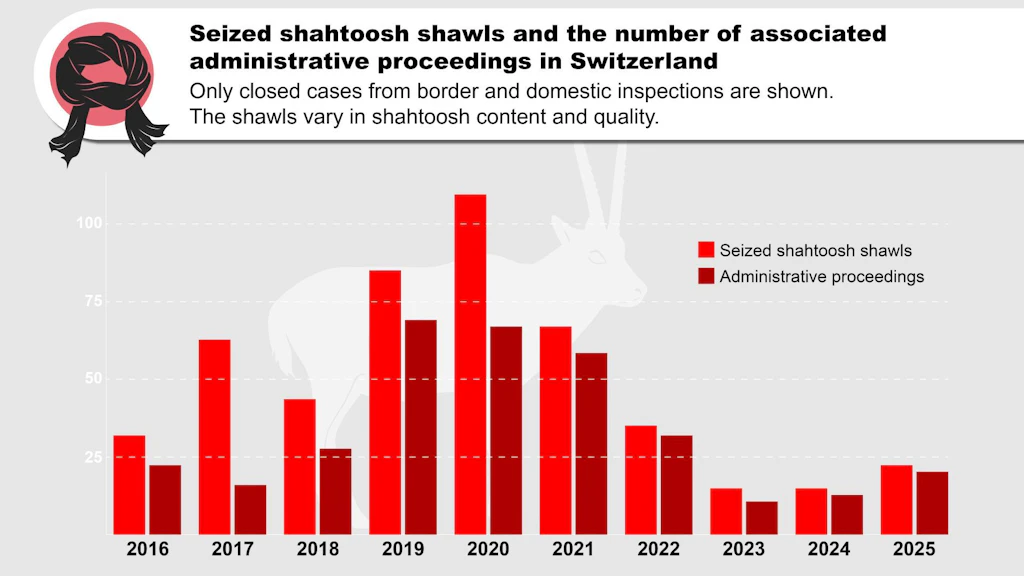
Shahtoosh shawls are considered luxury goods and can cost up to CHF 40,000. Switzerland is an importing country as there is a demand for these shawls here. Every year, shawls are intercepted by the FOCBS and subsequently seized by the FSVO. The consistently high number of interceptions shows that illegal trade still exists and is internationally organised.
To combat the shahtoosh trade, the FSVO works closely with Interpol, Europol and the producing countries. In addition, the FSVO conducts regular targeted inspections in collaboration with the FOCBS. This also involves raising awareness among people who wear such shawls, as they often claim that they were unaware of the origin of the wool.